How to Paddle a Surfboard: Beginner Guide to the White Water
Paddling is most of surfing. Here is how to lie on the board, paddle efficiently and get through the white water without being washed back to the beach.
Read this guide inFrançaisDeutschEspañolSvenskaPolskiNorskDansk
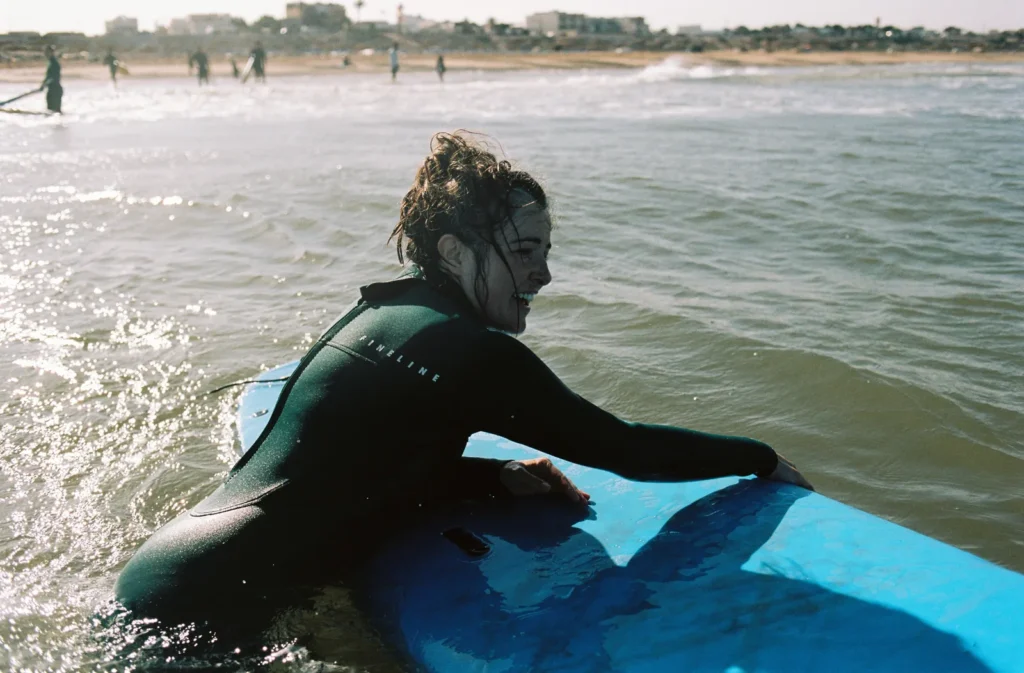
Ask any surf coach and they will tell you the same thing: surfing is mostly paddling. Standing up gets the photos, but you spend far more time lying on your board, stroking out through the white water and into position. Learning how to paddle a surfboard well is the fastest way to catch more waves, feel less tired and enjoy your sessions more. This guide covers the basics we teach every beginner at our camp in Tamraght.
Find the sweet spot on your board
Where you lie matters more than how strong you are. Too far back and the nose lifts up, the tail drags and you push water instead of gliding. Too far forward and the nose digs in, especially when a wave arrives.
- Nose check: the tip of the board should sit just above the water, about two or three centimetres.
- Centred: keep your body along the stringer, the line down the middle of the board, so you do not tip sideways.
- Feet together: legs together and toes at or near the tail. Spread legs act like brakes.
Many soft-tops have a logo or mark near the middle. Use it as a reference: once you find your spot, notice where your chin or chest sits and lie there every time.
Body position: chest up, eyes forward
Lift your chest slightly by arching your lower back, like a gentle cobra pose. Look forward towards where you want to go, not down at the board. This keeps your weight balanced, gives your arms room to reach, and lets you see the waves coming.
Do not arch so hard that your back aches after ten minutes. It should feel active but relaxed. Keep your head still and your neck long.
The paddle stroke
A good stroke is long, deep and rhythmic, a bit like front crawl in a pool but without rotating your whole body.
- Reach: extend one arm forward and enter the water with a slightly cupped hand, fingers together, close to the board.
- Pull: pull back under the board along the rail, keeping your elbow high.
- Push: finish the stroke by your hip, then lift the arm out and bring it forward again.
- Alternate: left, right, left, right, with a steady rhythm.
The most common beginner mistakes are short, splashy strokes, paddling with both arms at once, and paddling with the hands too wide. Keep your strokes close to the rails and dig deep. Quality beats speed.
Walking the board out in shallow water
At beginner beaches like Tamraght, Devil’s Rock or Crocro, you often start in waist-deep water. There is no need to paddle through that zone. Walk.
- Hold the board by its sides, beside you, nose pointing out to sea.
- Never put the board between you and an oncoming wave. If the white water hits the board, it can slam back into you.
- As a wave comes, push the nose up and over it, or lift the board slightly so the foam passes underneath.
- Shuffle your feet along the bottom to avoid stepping on anything sharp.
Once the water is about chest deep, lie down and start paddling.
How to get through the white water
Getting out past the broken waves is where most beginners lose energy. You have a few tools, and choosing the right one depends on the size of the wave and the depth of the water.
| Technique | When to use it | How it works |
|---|---|---|
| Walking over | Waist-deep water, small foam | Lift the nose over the white water as you walk |
| Push-up | Small white water while paddling | Push your chest up so the foam passes between you and the board |
| Turtle roll | Bigger white water on a soft-top or longboard | Roll upside down under the board and let the wave go over |
| Duck dive | Shortboards, for intermediate surfers | Push the board under the wave; not possible on a soft-top |
The push-up
For small foam, paddle straight at it with speed. Just before it reaches you, grip the rails at chest level and push your upper body up, like a push-up, keeping your hips on the board. The water flows through the gap. Keep the board pointing straight at the wave. If you are sideways, it will roll you.
The turtle roll
Soft-tops are too buoyant to push under the water, so the turtle roll is your best friend. Paddle towards the wave, and about a metre before it arrives:
- Grip both rails firmly near the nose.
- Take a breath and roll sideways, pulling the board over you so you hang underneath it.
- Pull the nose slightly down and hug the board towards you as the wave passes over.
- Roll back on top, find your spot and paddle straight away before the next wave.
It feels awkward the first few times. Practise it in calm water so it becomes automatic.
Timing the sets
Waves usually arrive in sets, a group of bigger waves followed by a calmer spell called a lull. Before paddling out, stand on the beach for a few minutes and watch. Count the waves in a set and notice how long the lulls last.
- Start paddling as the last wave of a set breaks.
- Look for channels: darker, calmer water where waves break less. Your instructor will point these out.
- If a set catches you halfway, stay calm, do your turtle rolls, and keep making progress between waves.
You can check the conditions before you head down on our live surf report.
Paddling for a wave
When you see a wave you want, turn the board towards the beach early, check that nobody else is on it (see our guide to surf etiquette for beginners), and paddle hard. The common mistake is stopping too soon. Keep paddling until you feel the board slide and pick up speed on its own, then take two more strong strokes before you pop up.
Building paddle fitness
Your shoulders will feel it after the first day, and that is normal. Paddling fitness comes mainly from time in the water, but a few things help:
- Swimming front crawl in the weeks before your trip.
- Shoulder mobility work and gentle stretching after each session.
- Yoga, which helps your back and shoulders recover between surf days.
- Resting properly: breaks, water and a good lunch between sessions.
If you are just starting, our guide to learning to surf in Morocco explains what to expect from your first week.
Learn it properly in the water
Reading helps, but paddling clicks fastest when someone watches you and corrects your position on the spot. At Surf Chill Vibe our local instructors teach in small groups in the water, so you get feedback on every stroke and turtle roll. Have a look at our surf packages, or get in touch if you have questions about your level.
Frequently asked questions
Why is paddling a surfboard so hard?
Paddling uses shoulder and back muscles most people rarely train, and beginners often lie in the wrong place on the board, which creates drag. Good position and long, relaxed strokes make a huge difference within a few sessions.
How do you get past the waves on a soft-top?
In shallow water, walk the board out and push it over the white water. Deeper, use the turtle roll: grip the rails, roll upside down under the board and let the wave pass over you.
Can you duck dive a soft-top surfboard?
Not really. Soft-tops and longboards are too thick and buoyant to push under the water, so beginners use the turtle roll instead.
How long does it take to get good at paddling?
Most people feel a clear improvement after a week of regular surfing. Paddling fitness keeps building for months, and the more time you spend in the water, the easier it gets.
Ready for waves?
Stay in Tamraght: surf, explore or simply rest
Pick a ready-made week or build your own trip with surf, day trips and meals, and see the full price before you send anything.